

Many cardiovascular diseases occur with damage to the walls of the arteries. These pathologies include:
- Arteriosclerosis is a more general concept and means rigidity or thickening of blood vessels with subsequent loss of elasticity.
- Atherosclerosis is a specific subtype of arteriosclerosis, in which the thickening of blood vessels is associated with the formation of plaques, resulting in narrowing of the arteries and blockage blood flow.
- Arteriolosclerosis is a thickening of the arterioles. Especially combined with systemic arterial hypertension
- Monkeberg's medial calcifying sclerosis (MCS) is calcification (calcium deposition) in the middle layer of the arteries, which does not cause their narrowing.
How does arterial stiffness affect pulse pressure and wave reflection
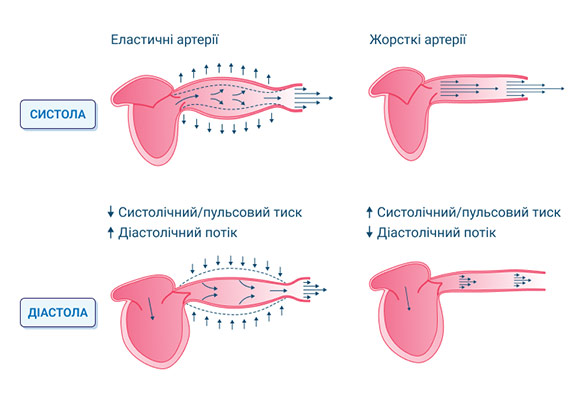 The elasticity of the arteries plays a key role in the energy optimization of the cardiovascular system. Part of the energy that the heart transfers to the blood during systole is directed to stretching the arterial walls, and during diastole, the aortic walls contract and return energy to the flow, ensuring normal blood circulation and protecting organs from damage. However, with age or in the presence of arterial hypertension (AH), the arterial walls become stiffer, which leads to an increase in the pressure required to move the blood.
This has a negative effect on blood circulation, increasing blood pulsation and pressure in small vessels, which leads to damage to the organs fed by these vessels.
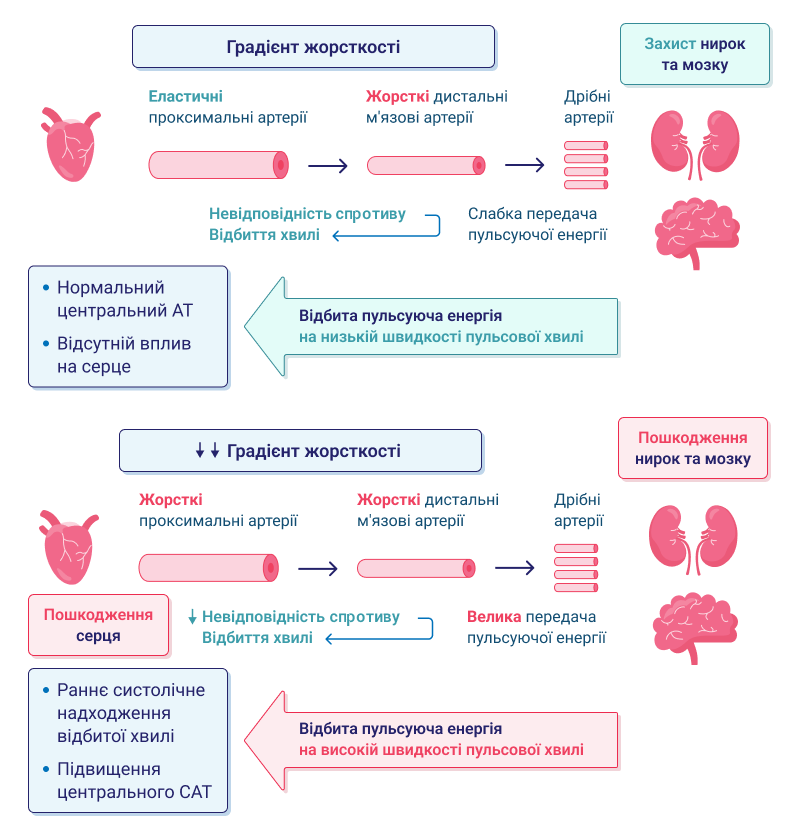
In older people, the pulsation of blood pressure is increased due to the phenomenon of wave reflection. The arterial system can be thought of as a viscoelastic tube with many branches and high resistance at the ends, causing reverse waves as a result of reflection. As the arteries stiffen, both direct and reflected waves are transmitted faster. That is why the reflected wave reaches the central aorta earlier, increasing the pressure in the late phase of systole and increasing the central pulse pressure.
In healthy people, most of the reflected pulsating energy slowly returns to the heart along the elastic arteries, without superimposing on the primary pressure wave. This allows central arterial pressure to remain within normal limits.
Who is at higher risk of having vascular stiffness?
Recent studies have expanded the list of major risk factors for arterial stiffness.
 These include:
- ethnicity,
- gender,
- age,
- high blood pressure,
- diabetes mellitus,
- obesity,
- metabolic syndrome,
- dyslipidemia,
- alcohol consumption,
- perceived stress,
- family and personal history, genetics,
- smoking and social deprivation, chronic kidney disease,
- poor nutrition and excessive salt intake.
How does arterial stiffness affect cardiovascular events?
Arterial stiffness and high blood pressure predict the risk of cardiovascular disease and kidney complications in patients with hypertension.
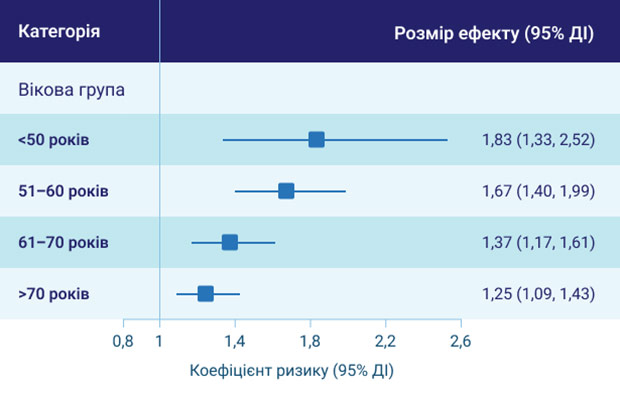
Research findings have shown that arterial stiffness is associated with an increased risk of coronary heart disease, stroke, and othertheir diseases. This risk persists with age, although it decreases in people over 50 years of age.
How to measure vascular stiffness?
To measure vascular stiffness,the method of calculating the pulse wave propagation velocity (PWV / SPPH) is used. This is a simple and reliable method that does not require surgical intervention. Most often, the pulse wave velocity is measured between the carotid and femoral arteries (carotid-femoral PWV / SPPH), this is important for assessing the condition of the aorta, since the aorta plays a key role in blood circulation.
During the measurement, the distance (D) traveled by the pulse wave and the time (Δt) it takes it to cover this distance are determined. Formula for calculation: PWV / SPPH = D / Δt.
Studies have shown that age and blood pressure are the main factors determining PWV / SPPH, and that at a certain age PWV / SPPH is higher in people with hypertension.
There are two main reasons for measuring arterial stiffness:
- Heart disease prognosis: Arterial stiffness helps predict the risk of cardiovascular diseases such as heart attacks and strokes.
- Aging prevention: Arterial stiffness shows how quickly the vessels are aging. Measuring stiffness helps to understand this and take measures to protect them.
Measuring vascular stiffness helps doctors better assess the risk of cardiovascular complications in older patients and choose the most effective treatment.
More details here